


Cold Calling Isn’t Dead. Bad Cold Calling Might Be.

Cold calling has apparently been dying for about 20 years.
Email was going to kill it. Then social selling. Then marketing automation. More recently, AI has been lined up as its latest replacement.
Yet businesses are still picking up the phone. And some of the sales teams using it most effectively are achieving results considerably better than the industry average.
So perhaps we’ve been asking the wrong question.
Instead of asking whether cold calling still works, it might be more useful to ask why some cold calling works remarkably well while other campaigns burn through thousands of prospects and produce very little.
Because the telephone isn’t really the problem.
Bad targeting, poor data, irrelevant conversations and badly timed calls are.
Cold Calling Isn’t Dead. But It Has Changed.
There’s some interesting recent evidence for this.
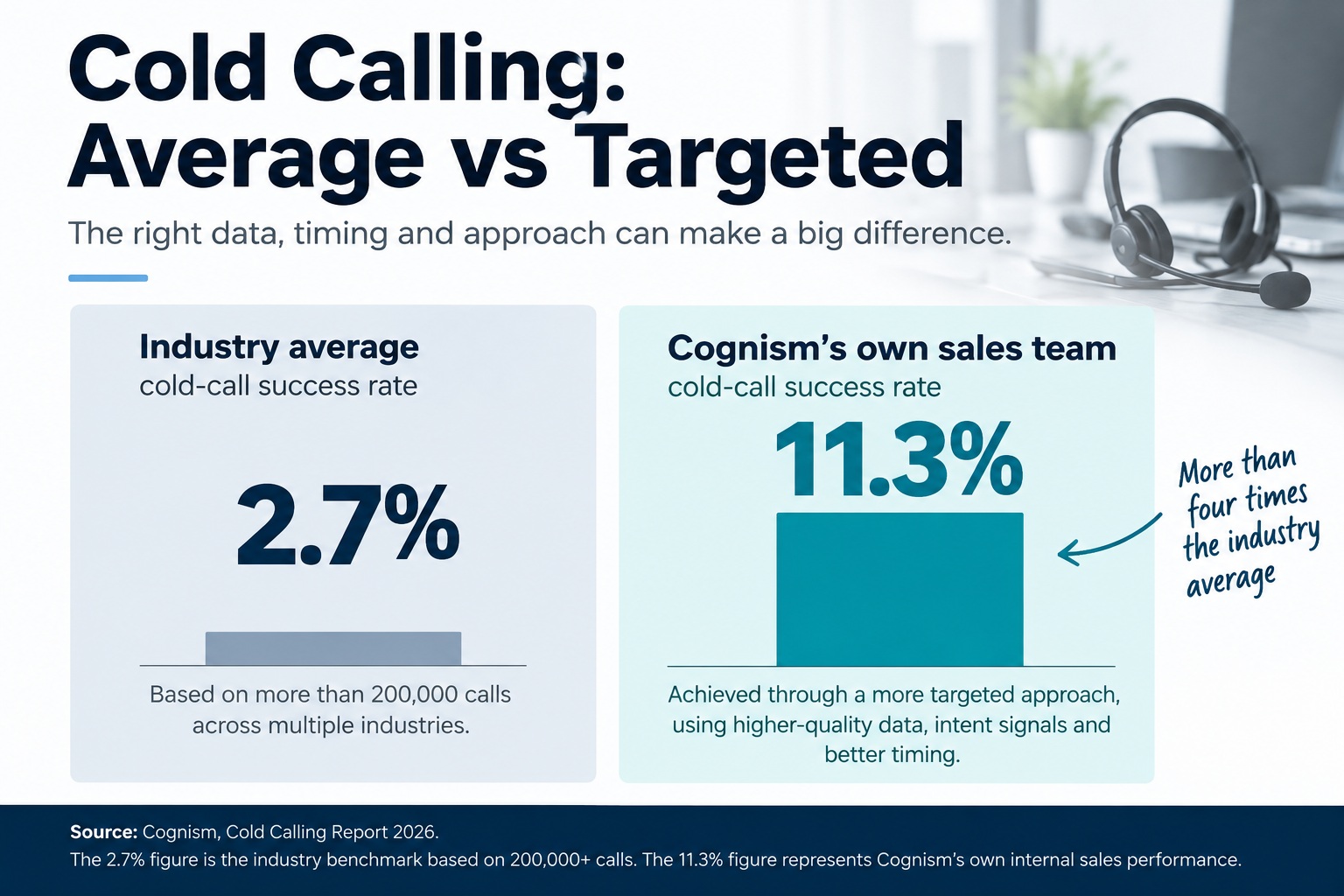
Cognism’s 2026 cold calling research, drawing on more than 200,000 calls, puts the industry cold-call success rate at 2.7%, up from 2.3% in the previous year.
That improvement is relatively modest.
What’s much more interesting is what happened inside Cognism’s own sales operation.
Its team reported an 11.3% success rate – more than four times the wider benchmark.
That number needs some context. It’s Cognism’s own result, not a realistic promise that every business adopting a particular technique will suddenly convert one in nine cold calls.
But the difference is still revealing.
Cognism attributes its performance to a much more precise approach: targeting better-fit accounts, using higher-quality data and intent signals, prioritising useful conversations over raw call volume and calling at more appropriate times.
In other words, it didn’t solve cold calling by simply making more cold calls.
It tried to make better ones.
The Old Numbers Game Is Looking Increasingly Expensive
There has always been a numbers element to telemarketing.
If you make one call, the chances of finding somebody with exactly the right requirement at exactly the right moment are obviously small. Make 100 relevant calls and you create far more opportunities for useful conversations.
But there’s an important difference between accepting that sales requires activity and assuming that more activity automatically means better results.
Imagine giving a salesperson a spreadsheet containing 5,000 businesses and telling them to start at the top.
Some won’t be suitable prospects.
Some records will be out of date.
Some contacts will have moved jobs.
Some businesses may be far too small or too large for the proposition.
Others might be excellent prospects, but the person listed isn’t remotely involved in the purchase.
Every one of those unnecessary calls costs something – even if the cost is simply the time of the person making it.
That’s why good outbound activity increasingly begins before anyone picks up the telephone.
Who are we trying to reach?
What makes a company a good prospect?
Which sectors, locations, company sizes or job functions are most relevant?
What do we already know about the organisation?
And, perhaps most importantly, why might this particular person have a reason to talk to us?
Team Telemarketing’s Data Procurement service is built around precisely this principle. Better-quality, properly targeted data gives a campaign a much stronger starting point than simply buying the biggest list available.
It doesn’t guarantee that somebody will want what you’re selling.
It does improve the chances that you’re talking to somebody who conceivably might.
Most People Don’t Hate Telephone Calls
They hate irrelevant ones.
That’s an important distinction.
Say you’re the Operations Director of an engineering business outside Reading. It’s 10.15 on Tuesday morning and somebody calls you.
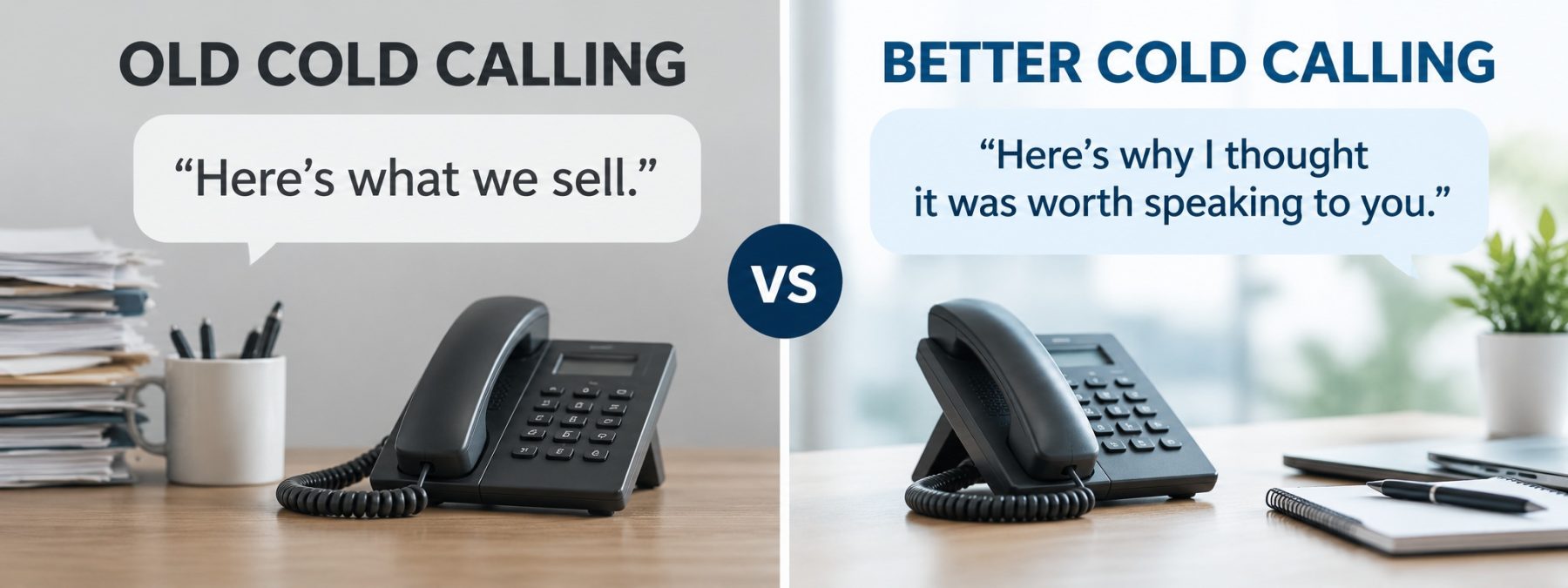
Within seconds, they’re explaining that their company was founded in 2008, has offices in three locations and offers an innovative range of market-leading solutions.
You haven’t yet been given any reason why this matters to you.
So you end the call.
Now imagine a different conversation.
The caller understands that you operate multiple production sites. They work with businesses facing a problem that commonly affects companies like yours. They explain briefly why they thought it was worth getting in touch and then ask a sensible question.
You may still say no.
But there’s a much better reason to stay on the phone.
This is where the distinction between a sales script and a business conversation becomes important.
A script is primarily concerned with what the caller wants to say.
A conversation has to take account of what the other person says back.
That’s why Team Telemarketing has always specialised in non-scripted calling. Telemarketers are briefed on the client’s business, proposition and market so they’re able to have a professional discussion rather than simply work through a fixed sequence of lines.
We’ve previously looked at the opening few seconds in more detail in How to Deliver a Great Introduction When Cold Calling. A good introduction matters, but what happens after it matters just as much.
A Good Call Doesn’t Always End With an Appointment
This is another area where measuring nothing but volume can give a misleading picture.
Suppose you’re selling specialist software to accountancy firms.
A telemarketer calls a practice in Cambridge and discovers they’re halfway through a three-year contract with a competitor.
No appointment.
Failure?
Not necessarily.
The conversation might establish when that contract ends, who will review alternatives, what the practice dislikes about its existing system and when it normally begins evaluating suppliers.
That’s useful sales intelligence.
Another call might discover that a logistics company in Slough has no current project but expects a new Operations Director to arrive next month.
Another might reveal that the person listed as Managing Director has nothing to do with the purchase and that responsibility actually sits with a Group Procurement Manager elsewhere in the business.
None has produced an appointment today.
All three could improve tomorrow’s sales activity.
This is particularly relevant in longer B2B buying cycles, where timing can be as important as persuasion.
The objective isn’t always to make somebody buy now.
Sometimes it’s to discover when a meaningful conversation will become possible.
A Cold Call Doesn’t Have to Be Completely Cold
The term itself is becoming slightly misleading.
A salesperson may never have spoken to the prospect before, but that doesn’t mean they need to know nothing about them.
Modern outbound teams have access to far more information than their predecessors did.
A company’s website can tell you what it does, where it operates and sometimes which markets it serves. LinkedIn can help identify relevant roles and organisational changes. CRM history can reveal previous conversations. Website activity and intent data may provide clues that an organisation is researching a particular subject.
AI can increasingly help with some of the research too – summarising company information, identifying potentially relevant developments and helping sales teams prioritise accounts.
The useful application of technology isn’t necessarily to replace the telephone conversation.
It’s to make the conversation less random.
That distinction is becoming particularly important as buyers themselves adopt AI and digital research.
Gartner research published in 2026 found that 45% of B2B buyers had used generative AI during a recent purchase, primarily to gather information about products and vendors.
Yet 69% said they preferred to validate AI-generated insights with a sales representative.
That’s a useful reminder that digital research and human conversation aren’t necessarily competitors.
Often they do different jobs.
We explored that relationship in more detail in AI vs Human Telemarketing: Finding the Right Balance in B2B Sales.
Getting Through Is Only the Beginning
There’s another reason the old volume model struggles.
Reaching somebody isn’t the same as engaging them.
Anyone can read a product description down the telephone. The difficult bit starts when the prospect responds.
“We’ve already got a supplier.”
“It’s not a priority at the moment.”
“Send me something by email.”
“We looked at this last year and decided against it.”
These are often treated as objections to overcome.
Sometimes they are.
But they’re also information.
“We’ve already got a supplier” can lead to a conversation about when the arrangement is reviewed.
“It’s not a priority” raises the question of whether that might change.
“We looked at this last year” may uncover exactly what prevented the project going ahead.
A capable telemarketer listens for those openings.
That requires judgement, product knowledge and enough confidence to move away from a predetermined script.
It also means accepting that sometimes the correct outcome really is “not interested”.
Good telemarketing isn’t about somehow forcing every prospect into an appointment.
Qualification protects the sales team’s time too.
Perhaps the Problem Isn’t Cold Calling. It’s Who’s Doing It.
One of the most interesting findings in Salesforce’s 2026 UK sales research has very little to do with whether cold calling works.
It concerns how salespeople feel about doing it.
Salesforce found that 44% of UK sales representatives identified cold calling as the worst part of their job.
At the same time, 36% said they didn’t have enough capacity to carry out adequate cold outreach – despite salespeople already spending almost a full working day each week on prospecting.
That presents an interesting management problem.
Imagine you’ve recruited an experienced Business Development Manager because they’re excellent at running meetings, understanding complex requirements, presenting solutions, negotiating contracts and closing valuable business.
How much of their week do you want them spending finding telephone numbers, navigating switchboards, updating contact records, leaving messages and trying to reach people who may not be available?
There’s nothing beneath them about doing those jobs.
It’s simply a question of where their time produces the greatest value.
And there’s another consideration.
Some excellent salespeople simply aren’t excellent prospectors.
The skills overlap, but they aren’t identical.
Someone who thrives when sitting opposite an interested prospect discussing a £100,000 project may genuinely dislike spending three hours creating those initial conversations.
That dislike can become visible surprisingly quickly.
The pace drops.
The difficult calls get postponed.
Research becomes something to do tomorrow.
Follow-ups become inconsistent.
And eventually the sales pipeline reflects it.
For a specialist telemarketing team, that activity isn’t an interruption to the real job.
It is the job.
There’s More to a Cold Call Than the Person Who Answers
Our previous article, Why Finding the Decision Maker Is No Longer Enough, looked at the increasing number of people involved in B2B purchases.
That has implications here too.
A traditional cold-calling campaign might have been built around identifying one senior decision maker and repeatedly trying to reach them.
Modern B2B buying often isn’t that tidy.
The first useful conversation might be with somebody who influences the purchase rather than signs it off.
A call to the Finance Director of a Bristol business could reveal that the project is being led by Operations.
Operations may explain that IT needs to approve it.
IT may tell you that the project is viable but won’t be considered until next year’s budget.
That doesn’t mean the original data was useless.
It means the conversation has improved it.
One of telemarketing’s less glamorous but extremely valuable functions is turning static prospect records into living account intelligence.
Who matters?
Who doesn’t?
What’s changing?
When should we call again?
What does this organisation actually care about?
A database can give you somewhere to start.
Conversations tell you where to go next.
Precision Doesn’t Mean Making Three Calls a Day
There’s a danger of taking the argument for quality too far.
Good targeting doesn’t eliminate the need for activity.
Telemarketing still requires enough calls to create opportunities. Prospects are in meetings. People work remotely. Calls go unanswered. Priorities change. Even a perfectly matched company may simply have no requirement.
So this isn’t an argument for replacing high-volume bad calling with tiny-volume over-researched calling.
Spending 45 minutes researching somebody before attempting a two-minute introductory conversation is unlikely to make commercial sense for most campaigns.
The balance lies somewhere in between.
Know enough.
Know why the company fits.
Have accurate enough data to reach the right part of the organisation.
Understand the proposition well enough to talk naturally.
Then make the call.
If there’s a conversation, listen.
If there’s useful information, record it.
If there’s an opportunity, progress it.
If the timing is wrong, establish when it might be right.
And if the company genuinely isn’t a prospect, move on.
That’s still a numbers game.
They’re simply better numbers.
The Phone Still Does Something Digital Channels Struggle to Do
Email is scalable.
LinkedIn is useful for visibility and research.
Content can educate potential buyers long before they’re ready to speak to sales.
AI can analyse enormous quantities of information in seconds.
All have a place in modern lead generation.
But a telephone conversation has one particular advantage.
It’s interactive.
You can ask a question you hadn’t planned to ask because of something the prospect has just said.
You can hear hesitation.
You can clarify a misunderstanding immediately.
You can discover that the apparent objection isn’t really the objection.
And sometimes you can learn more about an opportunity in five minutes than weeks of digital activity revealed.
That doesn’t make the telephone superior to every other channel.
It makes it different.
The strongest approach is often to let the channels support one another rather than continually asking which one should replace the others.
Cold Calling Before the Buyer Is Buying
There’s one final reason not to write off outbound calling.
By the time a prospect openly enters the market, you may already be late.
6sense’s 2025 B2B Buyer Experience Report, based on nearly 4,000 buyers, found that the eventual winning supplier was already on the buyer’s Day One shortlist 95% of the time.
It also found that buyers had previous experience with an average of 3.8 of the five vendors they considered.
That reinforces something we touched on in our buying-committee article.
Getting known before a formal purchasing exercise begins has value.
A well-handled introductory call doesn’t have to produce an immediate requirement to be worthwhile.
Perhaps a technology business in Bracknell isn’t changing its outsourced IT provider this year.
Fine.
But if the conversation establishes that its contract is reviewed every February, you’ve learned something useful.
If the prospect also remembers a professional conversation with somebody who understood their business, you’re no longer entirely unknown when that review comes around.
Compare that with appearing in their inbox for the first time two weeks after they’ve already drawn up a shortlist.
Cold calling can therefore have a role before demand becomes obvious.
Not to manufacture an urgent requirement where none exists, but to identify future opportunities and begin relationships early enough to matter.
Maybe We Should Stop Asking Whether Cold Calling Works
The question is too broad to be particularly useful.
Does advertising work?
Does email work?
Does social media work?
The answer to all of them is the same.
Sometimes extremely well. Sometimes terribly.
Execution matters.
The evidence doesn’t suggest that picking up the telephone has somehow stopped being effective in B2B sales. If anything, the gap between average cold-calling performance and some highly targeted operations suggests something more interesting.
How the call is prepared, targeted and handled matters enormously.
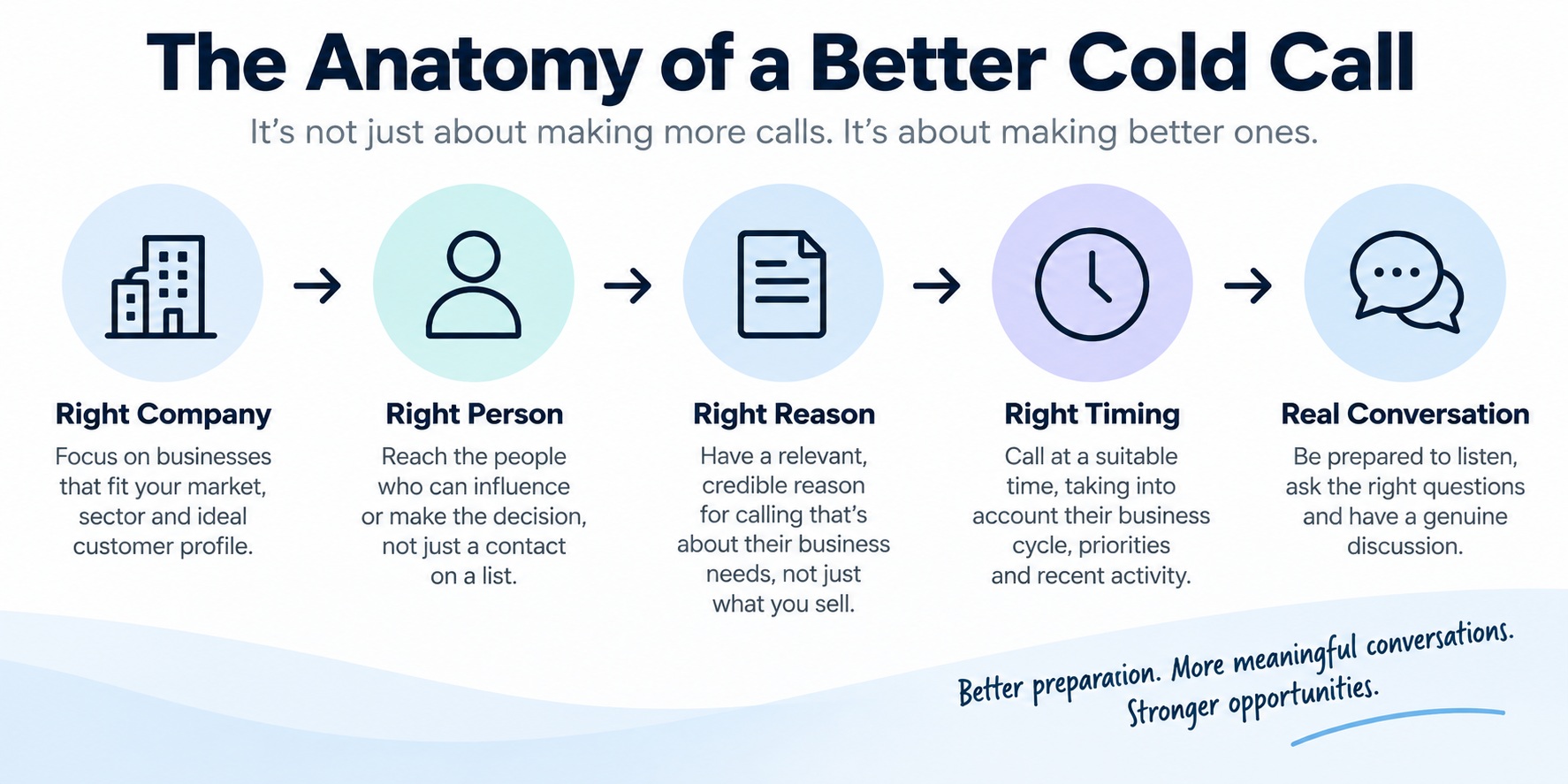
Start with the right companies.
Use accurate data.
Understand who you’re trying to reach.
Give them a credible reason to listen.
Have a conversation rather than reciting a pitch.
Record what you learn.
Follow up when there’s a reason to.
And put experienced people on the telephone who actually want to have those conversations.
Team Telemarketing’s Appointment Setting & Lead Generation service is built around that kind of targeted, professional approach – identifying genuine opportunities and allowing clients’ sales teams to concentrate their time on progressing and closing them.
Cold calling isn’t dead.
But calling enormous lists of poorly selected prospects, armed with little more than a generic script and a target for how many dials to make before 5pm?
We wouldn’t be particularly sorry to see that disappear.


