


Why Finding the Decision Maker Is No Longer Enough

The Rise of the Buying Committee
There was a time when one of the most important questions in B2B sales was relatively straightforward:
“Who’s the decision maker?”
Find that person, get through to them, establish whether there’s an opportunity and arrange a meeting.
It was never quite as simple as the sales textbooks suggested, of course. But today, for many B2B purchases, the idea of a single decision maker is becoming increasingly outdated.
Whether you’re selling specialist equipment to a manufacturer in the West Midlands or a new software platform to an insurance company in London, the challenge is increasingly similar. The person who first shows an interest may be only one of several people involved in the eventual decision.
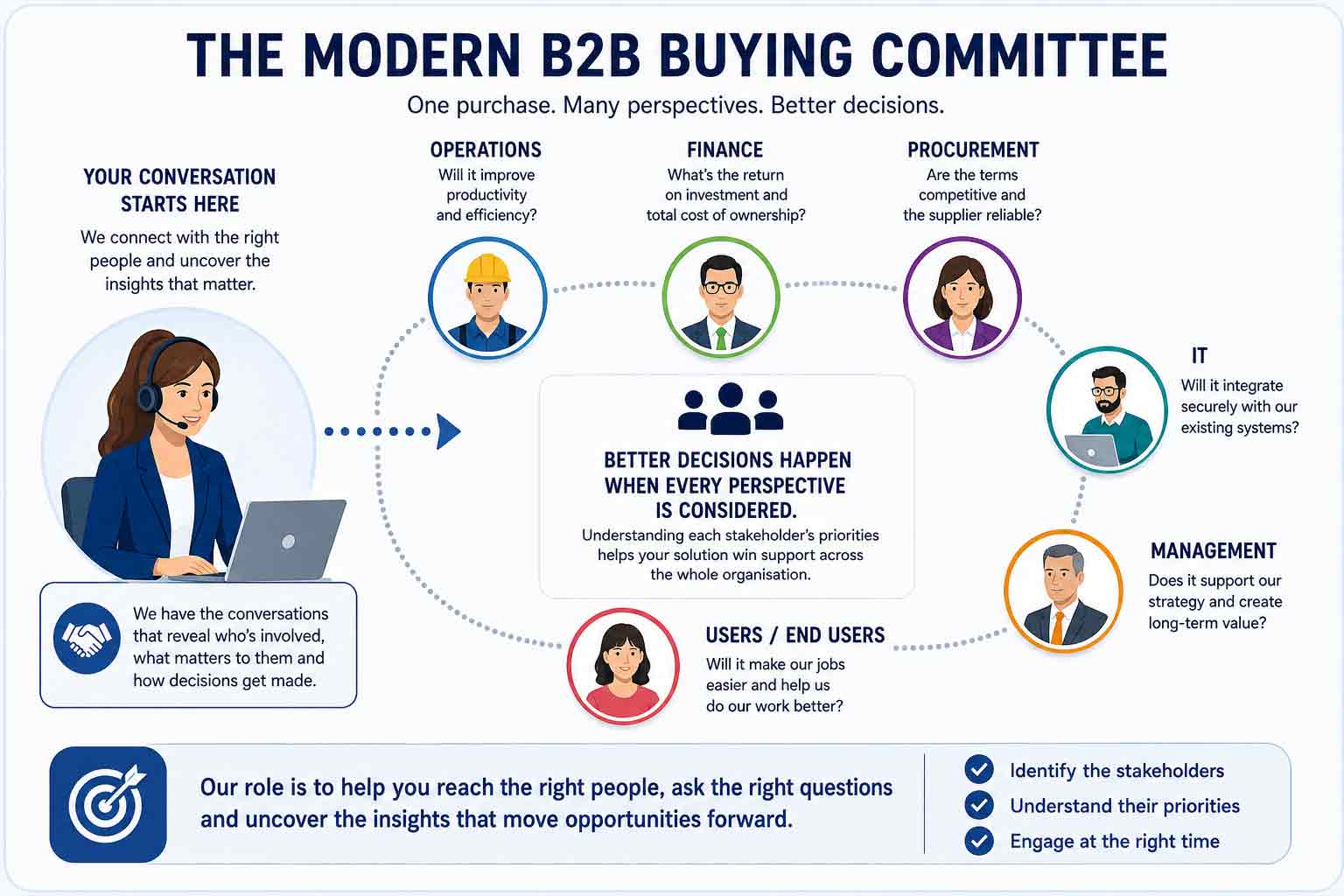
A piece of manufacturing equipment could involve operations, engineering, health and safety, finance and the people who will actually operate it.
Even comparatively straightforward business services can involve several people before a contract is signed.
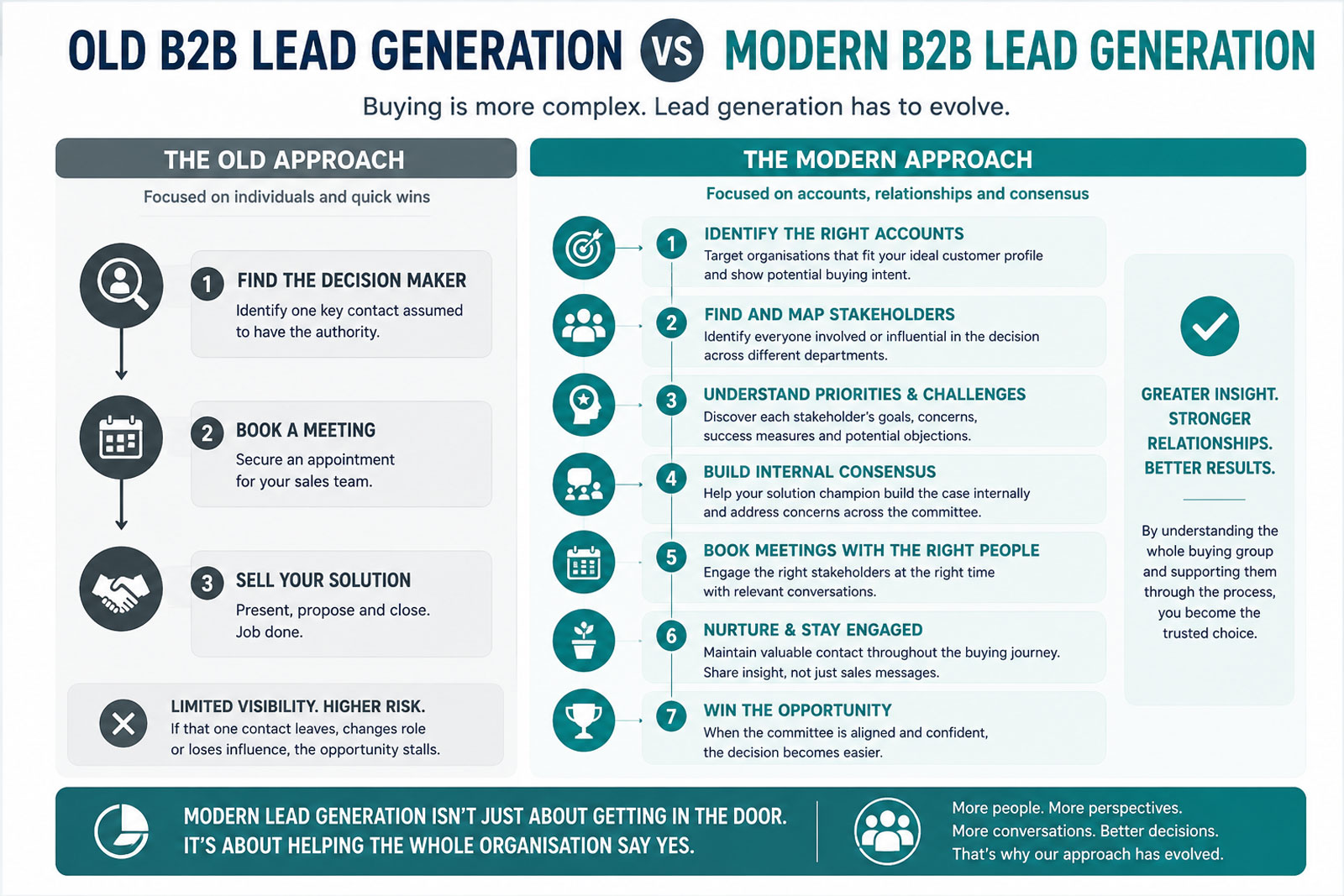
The result is a significant change in B2B lead generation.
Finding the right company still matters. Finding a useful contact within that company still matters.
But increasingly, neither is enough.
The real challenge is understanding the group of people behind the purchasing decision – and what each of them needs before they are comfortable saying yes.
Whatever Happened to the Decision Maker?
The scale of the change is striking.
Research from Gartner found that B2B buying groups can range from five to 16 people, spread across as many as four different business functions.
Forrester’s more recent 2026 research goes further. Its analysis puts the typical B2B buying decision at 13 internal stakeholders, with another nine external influences potentially contributing to the process.
Those numbers will obviously vary enormously according to what is being purchased. A £2,000 annual service contract isn’t going to require the same approval process as a £500,000 technology implementation.
But the direction of travel is clear.
Important business purchases are increasingly group decisions.
And groups make sales complicated.
Consider a business evaluating a new piece of production equipment.
The Operations Director may be interested in increased output. The Finance Director wants to understand payback and return on investment. Engineering wants reliability and straightforward maintenance. Procurement is looking at contractual terms and competing quotations.
The people who will actually use the equipment may have another concern entirely: is this going to make their working day easier or more difficult?
Everyone is discussing the same purchase, but they’re not necessarily buying the same thing.
That’s an important distinction for anybody involved in B2B lead generation.
The same principle applies well beyond manufacturing. An insurance company considering a new CRM platform, a logistics operator reviewing its fleet technology or a professional services firm choosing an outsourced supplier will all have their own version of the buying committee. The job titles change, but the problem doesn’t: different people judge the same purchase by different criteria.
The Biggest Obstacle May Be Inside the Prospect’s Business
The number of people involved isn’t even the most interesting part of Gartner’s research.
The research found that 74% of B2B buyer teams demonstrate what Gartner describes as “unhealthy conflict” during the decision-making process.
That can mean different stakeholders having conflicting objectives, disagreeing about the best course of action or finding their preferred decision overruled elsewhere in the organisation.
Anyone who has worked in B2B sales for long enough will recognise the situation.
You’ve had a great conversation.
The prospect likes the proposition.
There’s an obvious business case.
They’ve even told you they want to proceed.
Then…
“It looks good, but I’ll need to get the FD on board.”
Or procurement.
Or IT.
Or the Managing Director.
Suddenly, what looked like a very strong sales opportunity has stalled.
The interesting lesson isn’t that these people are deliberately obstructing purchases. They’re doing their jobs. Each has different responsibilities and therefore views risk differently.
Gartner found that buying groups which successfully reach consensus are 2.5 times more likely to report a high-quality deal.
That suggests something important for sales teams.
Winning a complex B2B sale isn’t simply about persuading one enthusiastic contact.
It’s often about helping several people become comfortable with the same decision.
Buyers Are Doing More Before They Ever Speak to You
At the same time as buying groups have become more complex, another major change has taken place.
Buyers have become far more independent.
Twenty years ago, speaking with a salesperson was often an essential part of researching a product. Suppliers controlled much of the information buyers needed.
That’s no longer the case.
Today, a potential customer can research your business, compare competitors, read case studies, check reviews, watch demonstrations, investigate your staff on LinkedIn and increasingly ask an AI assistant to summarise the entire market before anybody from your sales team knows they exist.
The numbers illustrate just how significant this has become.
Research published by 6sense found that B2B buying groups typically involve ten or more people, with the average buying journey in its 2025 study lasting just over ten months.
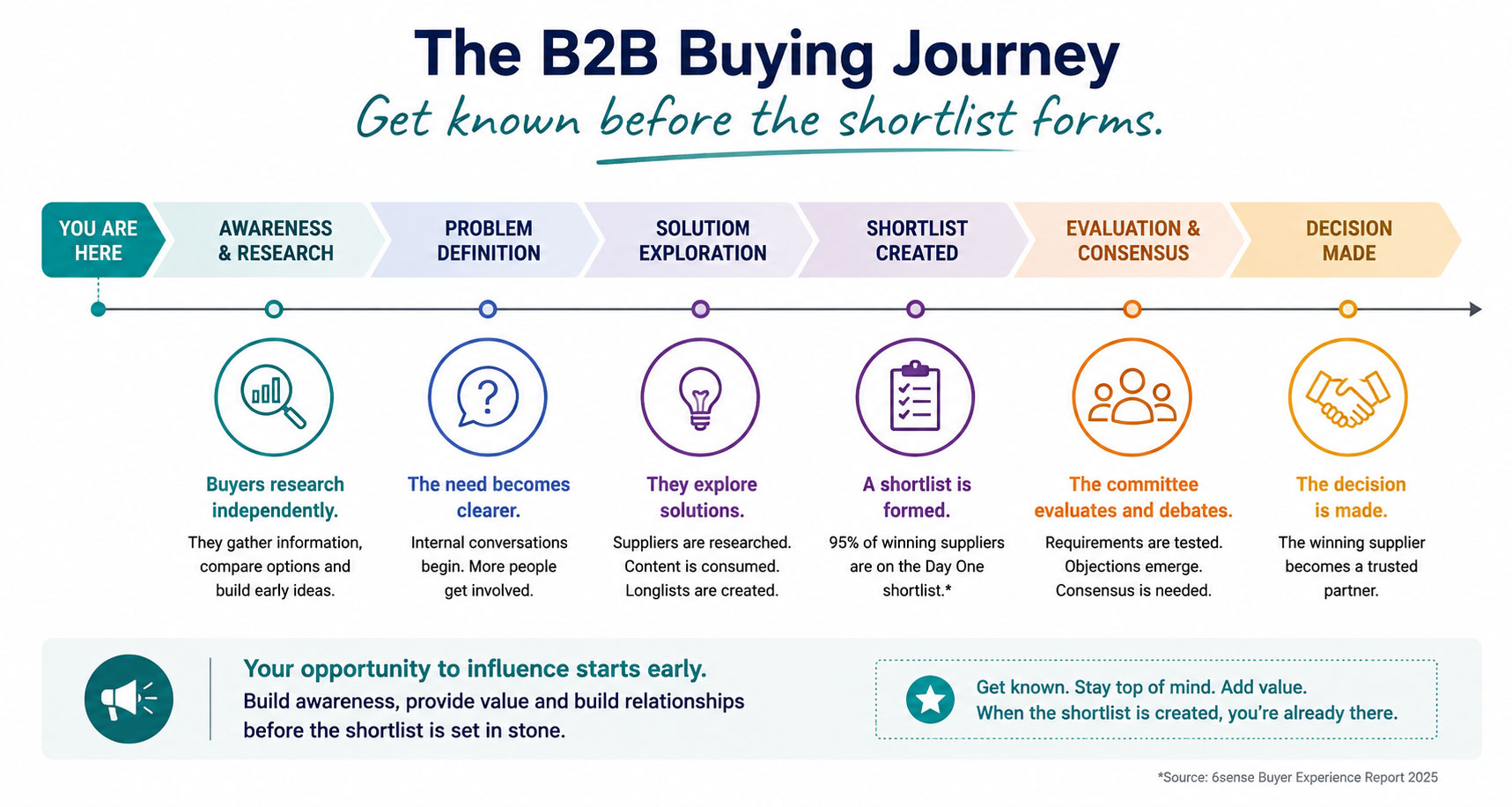
More remarkably, the study found that 95% of winning suppliers were already on the buyer’s shortlist on the first day of the buying journey.
Buyers aren’t necessarily waiting for salespeople to help them create a shortlist.
Increasingly, they’re creating the shortlist themselves.
Gartner’s 2026 research paints a similar picture. It found that 67% of B2B buyers prefer a sales-rep-free experience and 45% had used AI during a recent purchase.
At first glance, statistics like those might sound like terrible news for telemarketing.
We don’t think they are.
They do, however, change what good telemarketing needs to achieve.
The Cold Call Has a Different Job Now
If a prospect can obtain almost unlimited information online, there is little value in calling simply to repeat information they could have read on your website.
“Hello, we supply X and we’ve been established for Y years…”
They may already know.
What they probably don’t know is whether you understand their particular situation.
And you don’t know theirs.
That’s where a good conversation becomes valuable.
A telemarketing call might reveal that the company isn’t currently buying, but its existing contract expires in six months.
It might reveal that the person you’re speaking to loves the product, but finance rejected a similar proposal last year.
You may discover that another division has already successfully used your service.
Or that the apparent decision maker is actually an influencer and somebody entirely different controls the budget.
None of these conversations necessarily produces an immediate appointment.
But none of them is a failure either.
They produce intelligence.
That’s particularly important when buyers are researching independently because the organisation that understands the buying landscape has a much better chance of knowing when – and how – to engage.
Anyone who has spent time making B2B calls will recognise how quickly an apparently straightforward prospect can become more complicated. You might call a factory in Sheffield expecting to speak to the Operations Director, only to discover that the project is being driven by a Group Sustainability Manager based 100 miles away and that final approval sits with a finance team at head office.
Team Telemarketing’s approach to appointment setting and lead generation has always focused on qualified opportunities rather than simply filling a sales team’s diary. In a buying-group environment, that distinction becomes even more important.
From Finding Contacts to Mapping Accounts
This also changes the value of prospect data.
A traditional sales database might contain a company name, telephone number, email address and one senior contact.
Useful? Certainly.
Complete? Increasingly, no.
For a significant B2B opportunity, the more useful picture might include the original contact, other stakeholders involved in the purchase, who controls the budget, who influences the technical decision, the current supplier, likely renewal dates and any known objections.
In other words, the goal moves from finding a contact to understanding an account.
This doesn’t mean businesses need enormous quantities of information before making a call. Quite the opposite.
Some of the best intelligence is discovered through conversations.
A carefully targeted call can confirm whether information is correct and uncover details that aren’t available from commercial databases or LinkedIn.
That’s why good prospect data and human-led research work particularly well together. Team Telemarketing’s Data Procurement service can identify organisations and contacts using criteria such as job title, sector, employee numbers, turnover and location. The conversation can then add the context that turns a record into a genuine sales opportunity.
This also follows naturally from our recent article on the importance of data in B2B telemarketing. Accurate data gets you to the right organisation. Good conversations tell you what’s actually happening inside it.
Imagine Selling an Energy-Efficiency Solution
Consider a Midlands manufacturer selling an energy-efficiency system to large industrial premises.
Its prospecting identifies a sizeable manufacturing business that appears to be a perfect fit.
The telemarketer speaks with the Facilities Manager.
There’s genuine interest. Energy costs are a concern, the company has sustainability targets and the proposed system could produce measurable savings.
Ten years ago, that might immediately have been labelled a hot lead.
And it still is a good opportunity.
But it isn’t necessarily ready to buy.
The Facilities Manager needs the Operations Director to be satisfied that installation won’t disrupt production.
Finance wants evidence that the savings justify the investment.
Procurement wants alternative quotations.
The Sustainability Director is interested, but needs to know how the project contributes towards the company’s wider environmental targets.
Suddenly one sales lead has become five different conversations.
The mistake would be repeatedly calling the Facilities Manager and asking:
“Have you made a decision yet?”
A better approach is to understand the process.
Who else is involved?
What information do they require?
What’s the likely timescale?
Is budget already available?
When does the next capital expenditure review take place?
What might prevent the project going ahead?
The answers allow the sales team to support the buying process rather than simply chase it.
That’s a very different kind of lead generation.
The Appointment Isn’t the Finish Line
Appointment setting is understandably measured by appointments.
It’s a tangible result. A date goes into the salesperson’s diary and an opportunity progresses.
But in complex B2B sales, the first appointment is often closer to the starting line than the finish.
An initial meeting might introduce another stakeholder. A technical demonstration could bring IT or engineering into the conversation. A proposal may trigger involvement from procurement.
That’s why follow-up matters.
Not endless calls asking whether a decision has been made, but useful contact at sensible points throughout the buying process.
Our previous article on how to improve follow-up calls explored this in more detail. Good follow-up maintains momentum without becoming a nuisance.
It can also uncover changes.
Budgets appear.
Priorities shift.
People change roles.
Contracts approach renewal.
Projects that were “not happening this year” suddenly become urgent.
The fact that a buying committee couldn’t reach agreement in March doesn’t mean the opportunity is dead in September.
For longer B2B sales cycles, patience can be every bit as valuable as persistence.
AI Can Spot Activity. People Can Discover What It Means.
There’s another interesting development here.
AI and intent-data technology are becoming increasingly good at spotting account-level activity.
Perhaps several people from the same organisation have visited your website.
Someone downloaded a technical guide.
Another person looked at pricing.
A third visited a case study.
Technology can join those dots and flag the account as potentially active.
What it can’t necessarily tell you is what’s happening in the meeting room.
Perhaps the company is actively purchasing.
Perhaps somebody is preparing next year’s budget.
Perhaps they’re researching on behalf of a customer.
Or perhaps an existing supplier has increased its prices and they’re simply checking alternatives.
That’s where human conversation adds context.
Interestingly, even as buyers become more comfortable using AI themselves, they haven’t stopped valuing human expertise.
Gartner reported in May 2026 that 69% of B2B buyers prefer to validate AI-generated insights with a sales representative. Buyers in its research used an average of seven information sources during a recent purchase.
That’s a fascinating combination.
Buyers increasingly want the convenience of researching independently, but they still want knowledgeable people available when they need reassurance, context or clarification.
We explored this relationship between technology and human interaction in our recent article, AI vs Human Telemarketing: Finding the Right Balance in B2B Sales.
The same principle applies here.
Technology can tell you that something may be happening.
A conversation can help you understand what.
Familiarity Matters More Than Many Sales Teams Realise
There’s one final piece of research that deserves attention.
6sense found that buyers usually have considerable previous experience with the suppliers they consider. In its 2025 research, buyers reported prior experience with an average of 3.8 of the five vendors on their shortlist.
Forrester has found something similar from a different angle. Its research into trusted information sources found that 82% of B2B buyers trust coworkers and management, while 79% trust vendors they already work with.
That creates an obvious advantage for incumbent suppliers.
But it also provides a useful lesson for businesses trying to win new customers.
The purpose of lead generation isn’t always to create an immediate sale.
Sometimes it’s simply to make sure your business isn’t a stranger when the buying journey begins.
This makes activity before the formal buying process particularly important. If businesses are largely choosing from companies they already know, being visible and establishing relationships before an immediate requirement exists can be commercially valuable.
A useful conversation today may become an opportunity six months from now.
A prospect who isn’t ready to change supplier might still remember the company that understood their business and kept in touch without constantly trying to sell to them.
By the time a formal buying process starts, that familiarity matters.
If 95% of winning suppliers are already present on the buyer’s initial shortlist, getting known before the purchase begins becomes extremely valuable.
What Does This Mean for B2B Lead Generation?
It means we probably need to stop thinking about leads as individual people.
A lead may begin with one person, but the opportunity belongs to an organisation.
That changes the questions worth asking.
Not simply:
“Is this person interested?”
But:
“What’s happening inside this company?”
Who else is involved?
What problem are they trying to solve?
What would stop the purchase?
When could it realistically happen?
And what information will different stakeholders need before they can agree?
None of this makes B2B lead generation easier.
Quite the opposite.
But it does make well-researched, intelligent telemarketing more valuable.
When prospects can find basic product information themselves, there’s little benefit in simply reading a sales message down the telephone.
The value lies in having genuine business conversations, asking intelligent questions, listening to the answers and gradually building a picture of the opportunity.
That’s particularly relevant to Team Telemarketing’s unscripted approach. Our telemarketers are trained to understand the client’s sector, products and objectives so they can have professional discussions rather than simply work through a rigid call script.
The Decision Maker Hasn’t Disappeared. They’ve Acquired Colleagues.
B2B buying is unlikely to become simpler.
AI will give buyers access to more information. Procurement teams will continue scrutinising expenditure. Larger organisations will involve specialists from different departments. And businesses facing uncertain economic conditions will understandably want greater confidence before committing money.
For sales and marketing teams, that means the old obsession with finding the decision maker needs to evolve.
Of course you still need to reach people with influence.
But increasingly, successful lead generation is about understanding the network around them.
The right company.
The right people.
The right information.
The right conversation.
And, importantly, the right time.
Because behind many apparently straightforward B2B purchases now sits a group of people with different priorities who somehow have to reach the same conclusion.
The job of modern lead generation isn’t simply to find somebody who can say yes.
It’s to understand everyone who needs a reason not to say no.


